
At 12:01 a.m. ET on Friday, July 24, a tariff that touches almost everything America imports is set to disappear.
Not because anyone repealed it. Because the law it was built on has a built-in timer, and the timer runs out this week.
So here’s the question everyone actually cares about: does anything at the store get cheaper?
Short answer: maybe, eventually, on some things. Let me walk you through it, because the honest answer is more useful than the exciting one.
I’ve been feeling this one personally. The meat prices at Costco lately have me doing math in the aisle that I never used to do. So when I hear a big tariff is expiring, my first thought isn’t policy — it’s “okay, does this mean anything for my cart?”
The 60-second backstory
In February 2026, the Supreme Court struck down the tariffs the administration had imposed under a law called IEEPA. Within days, the White House switched to a different law — Section 122 of the Trade Act of 1974 — and put a 10% surcharge on most imports from most countries.
Section 122 comes with a catch: it only lasts 150 days unless Congress votes to extend it. Day 150 is July 24, 2026.
Congress hasn’t moved to extend it, and the president can’t extend it on his own. So barring a surprise, the 10% surcharge ends this week.
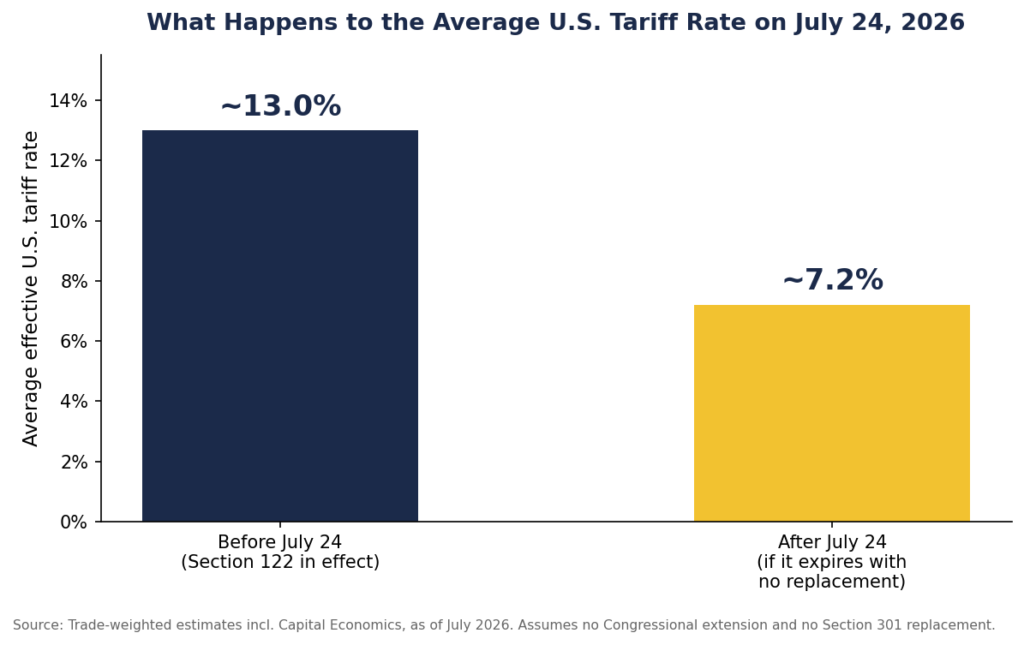
That’s a big number. The average effective tariff rate on U.S. imports is expected to fall from roughly 13% to around 7% — the largest single drop in the current tariff era.
The catch: it may not simply vanish
Before you celebrate, here’s what’s actually happening.
The 10% Section 122 surcharge is ending — but a replacement is already lined up. The U.S. Trade Representative has finalized new tariffs under a different law (Section 301) that put duties of about 12.5% on imports from 46 countries. For those countries, that’s not relief — it’s a small increase, from today’s 10% to 12.5%.
There’s more moving this same week: a separate 25% tariff on most goods from Brazil takes effect Wednesday, July 23.
So the honest headline isn’t “tariffs are over.” It’s “one layer is ending, another is taking its place, and the net effect depends entirely on where your stuff comes from.”
One important difference: unlike Section 122, these Section 301 tariffs have no expiration date and no rate cap. The temporary phase of this is ending. The durable phase is beginning.
What won’t change at all
This is the part most coverage skips, and it matters for your budget.
A lot of tariffs have nothing to do with Section 122 and don’t move this week at all:
Cars and car parts still carry their own separate 25% tariff. Steel, aluminum, copper, and lumber — think appliances, tools, anything metal-heavy — still carry duties around 25%. Most goods from China still face separate China-specific tariffs that aren’t expiring. Goods from the EU moved to a negotiated 15% ceiling on July 1, so this week changes nothing for them.
If your budget pain is a car, a fridge, or a washing machine — July 24 probably isn’t your moment.
Why your receipt won’t change on Friday
Even where a tariff really does drop, don’t expect the store to feel different this weekend. Two reasons.
First, tariff costs move through the system slowly. Federal Reserve researchers found that when these tariffs went on, it took roughly seven months for the full cost to show up in consumer prices. The pipeline works the same way in reverse — goods already on shelves were imported at the old rates.
Second, prices are sticky on the way down. Companies raised prices citing tariff costs. When those costs fall, lowering prices is a choice, not a requirement. Competitive categories like electronics and apparel tend to pass savings along faster. Concentrated categories tend to take their time.
For scale: the Fed estimates the 2025 tariffs raised core goods prices by about 3.1%. Any unwinding will be gradual and uneven — a slow leak, not a wave.
So what should you actually do?
A few practical calls, category by category.
Worth waiting a few weeks if you can: imported goods from countries that were only hit by the 10% surcharge and aren’t on the new 46-country list. If a retailer’s costs drop, late-summer and fall sales are where you’d see it.
Don’t bother waiting on: cars, large appliances, anything steel- or aluminum-heavy, most China-made goods, and anything from Brazil. Their tariffs are staying or rising.
Groceries: mostly driven by other forces right now. Coffee was up 33% year over year in January, and beef prices are forecast to rise over 9% this year — weather, herd sizes, and global demand are doing most of that, not the surcharge. Its removal helps imported items at the margins, but it won’t rescue the meat aisle. (Which explains my Costco math.)
Here’s a small real-life example of how this plays out. My son’s at a county summer camp this month, and he needed a lunch bag. I stood there debating whether to buy a nicer one — then grabbed a $3.99 bag at Trader Joe’s instead. That little decision is the whole game right now: when prices feel unpredictable, “good enough and cheap” starts winning. Multiply that by a whole country of shoppers making the same call, and you understand why some prices come down slowly and others don’t come down at all.
The bottom line
July 24 is a real deadline with real money attached. But it’s a reshuffle, not a rollback. One tariff ends, another begins, and a third (Brazil) lands the same week.
What decides your cart this fall isn’t the expiration — it’s the replacement. And unlike the thing that’s expiring, the replacement doesn’t come with a timer.
I work in international trade, so I watch tariff schedules change constantly — and I’ve learned they change a lot faster than prices do. A new rate can take effect overnight. The meat counter takes its sweet time. If you remember one thing this week, remember that gap.